
















Cross docking is a logistics method in which goods are transferred to their next destination almost immediately after arriving at a distribution center. Instead of storing products for an extended period, they are sorted, consolidated, or divided and then shipped directly.
This approach helps organizations shorten lead times, reduce inventory costs, and get goods to customers or retail locations more quickly. Cross docking is widely used in sectors such as retail, e-commerce, and food logistics to organize product flows more efficiently.
What does cross docking mean?
The term cross docking refers to bypassing the traditional storage phase within a logistics process. Goods are received at a distribution center and often leave the facility within a matter of hours or days.
Where a warehouse is normally used for storage, cross docking focuses on speed and throughput. Products remain at a single location for as little time as possible and are prepared almost immediately for onward transportation.
An example is a retailer receiving goods from multiple suppliers. Instead of placing these products into inventory, they are immediately sorted by store and then shipped to the correct destination. This creates a faster and more efficient flow of goods.
Cross docking is not about storage but about moving goods through the supply chain as efficiently as possible.
How does cross docking work?
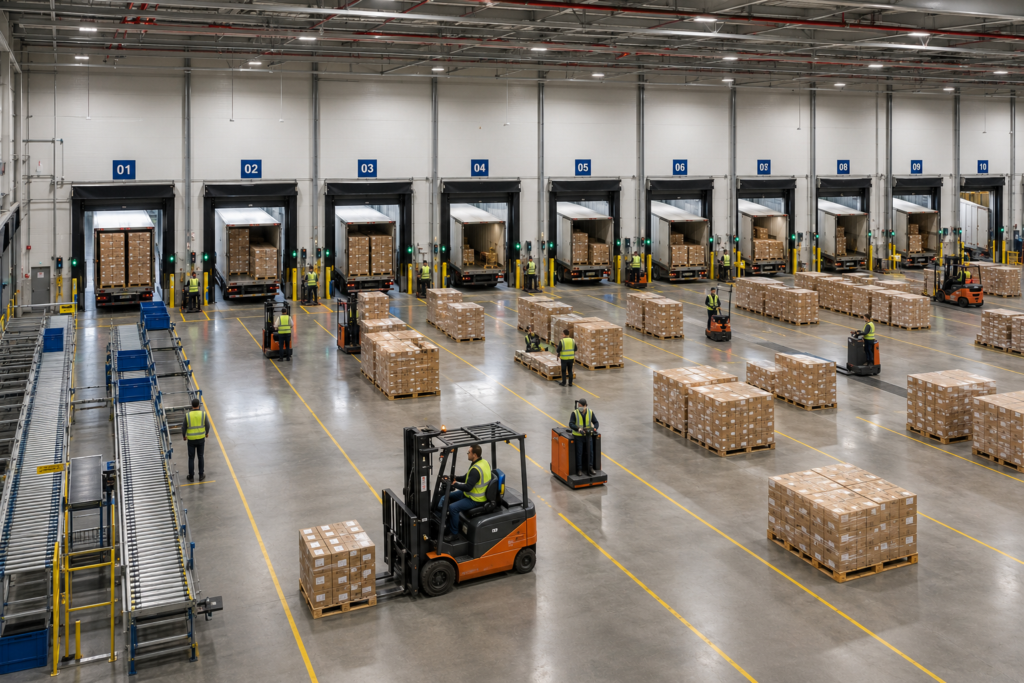
In cross docking operations, goods arrive through inbound transportation. The products are then inspected, sorted, and directly assigned to outbound shipments.
In practice, this process generally follows three steps. First, goods are received from suppliers or manufacturers. Next, the products are sorted by customer, region, or delivery address. Finally, the goods are loaded into outbound vehicles that distribute the products further.
Because goods remain in the distribution center for only a short period, accurate planning and strong coordination between all involved parties are essential. Modern logistics systems play an important role in this process. Real-time visibility into inventory, transportation, and orders helps ensure efficient product flows and prevents delays.
Why do companies use cross docking?
Companies choose cross docking because it offers several logistics advantages. By avoiding long-term storage, the total lead time of a shipment can be significantly reduced.
In addition, cross docking helps lower inventory levels. Less storage often means lower warehouse costs and less capital tied up in inventory. This makes the supply chain more flexible and better able to respond to changes in supply and demand.
Cross docking is primarily used for high-turnover product flows. Examples include supermarket products, consumer goods, promotional items, or products that need to be quickly available in stores and distribution networks.
The more predictable the product flow, the greater the likelihood that cross docking can be successfully implemented.
Benefits and considerations of cross docking
Benefits
Shorter lead times
Goods reach their final destination more quickly because storage is largely eliminated.
Lower inventory costs
Reduced storage requirements and lower inventory levels can result in cost savings.
More efficient product flows
Products are processed and moved through the logistics network more quickly.
Improved product availability
Fast throughput helps ensure that stores, distribution points, or customers receive products on time.
Considerations
Accurate planning is essential
Cross docking only works when inbound and outbound transportation are carefully coordinated.
Not suitable for every product flow
Products with unpredictable demand or long-term storage requirements are often less suitable for cross docking.
Dependence on real-time visibility
A strong information flow is necessary to process goods quickly and accurately.
How can a logistics partner support this?
Cross docking requires an efficient combination of transportation, planning, and distribution. A logistics partner can help organize these product flows by centrally managing processes and providing real-time visibility into orders and transportation activities.
Within modern supply chains, cross docking is often combined with warehousing, distribution, and contract logistics. Depending on the product flow, a combination of these logistics solutions can contribute to a more efficient supply chain design.
For organizations striving for faster deliveries, lower inventory costs, and improved product flow, it can be valuable to explore the role that cross docking can play within their logistics network.