















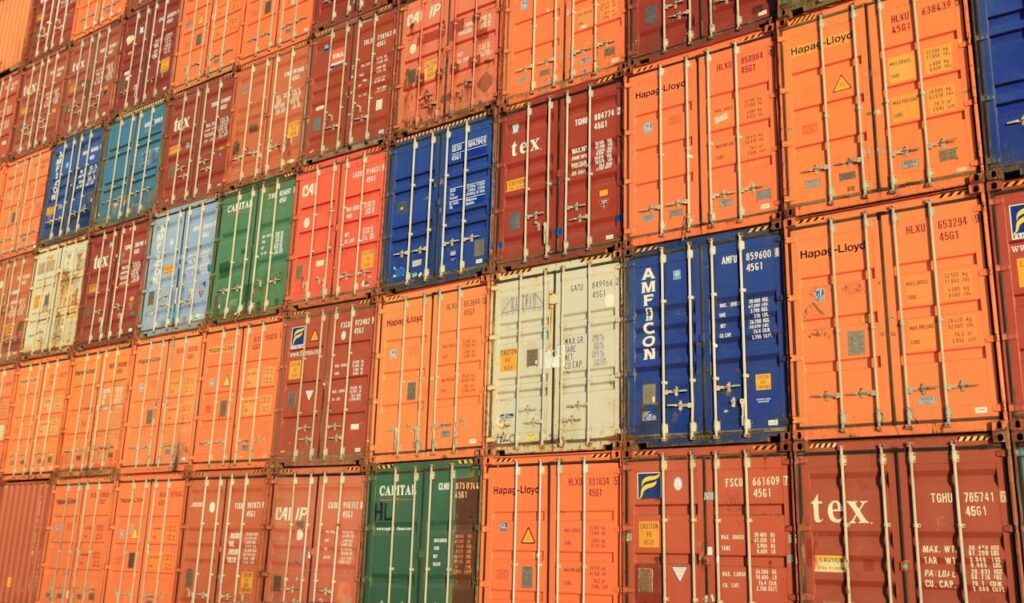
Container transport is the transportation of goods in standardised containers between different locations or countries. These containers are used to transport products safely, efficiently and clearly via trucks, ships, trains or a combination of transport methods.
Within international logistics, container transport plays an important role in organising international goods flows. Containers make it possible to efficiently load, store and transport large quantities of goods within complex supply chains.
How does container transport work?
In container transport, goods are loaded into a container which is then transported to a warehouse, distribution centre, port or final destination.
The process usually consists of several steps:
- Loading goods into the container
- Transport to a port, warehouse or distribution point
- Transhipment between different modes of transport
- International distribution to the final destination
Because containers have standardised dimensions, they can be efficiently processed within international logistics networks.
Within international transport, container transport companies help organise goods flows in a scalable and manageable way.
What types of container transport are there?
Container transport can be organised in different ways, depending on the goods flow and the volume of freight.
FCL container transport
FCL stands for Full Container Load. In this case, one company uses an entire container for its goods.
This is especially interesting for:
- large volumes
- international distribution
- fixed goods flows
- long-term supply chain operations
FCL often offers more control over planning and handling.
LCL container transport
LCL means Less than Container Load. In this case, multiple companies share one container.
This is interesting for organisations transporting smaller volumes that do not require a full container. By combining goods flows, transport costs can be distributed more efficiently.
Within groupage, a similar principle is applied to shared transport flows.
Why is container transport widely used?
Container transport offers many advantages within international logistics. Containers make it easier to transport goods safely and efficiently between different countries and logistics hubs.
In addition, containerisation helps to:
- better protect goods
- shorten loading and unloading times
- organise transport more efficiently
- make international distribution scalable
Because containers can easily be transferred between trucks, ships and terminals, greater flexibility is created within supply chains.
For companies operating internationally, this is important to keep goods flows predictable and manageable.
What does container transport mean in practice?
In practice, container transport plays an important role in international supply chains. Products are often transported between:
- manufacturers
- ports
- warehouses
- distribution centres
- retailers
- end customers
This is not only about transport, but also about planning, storage, tracking and coordination between different logistics parties.
Delays, capacity problems or planning errors can directly affect stock availability and delivery times. That is why real-time insight is becoming increasingly important within container logistics.
Within distribution, good coordination helps to efficiently process and deliver international goods flows.
What role does real-time tracking play in container transport?
International goods flows often consist of multiple links. As a result, companies increasingly want insight into the location and status of containers.
With real-time tracking, organisations can:
- track containers during transport
- identify delays faster
- plan deliveries more effectively
- inform customers better
In addition, real-time insight helps organisations respond faster when transport planning changes.
Within modern supply chains, transport management systems (TMS) are therefore increasingly used to manage international container flows more efficiently.
What challenges are associated with container transport?
Although container transport offers many advantages, it also involves challenges.
Important points of attention are:
- International planning
Container flows must be well coordinated between different countries, terminals and carriers - Capacity and availability
Available containers and transport capacity can fluctuate. - Transport costs
Fuel prices, port charges and international routes affect total costs. - Customs and documentation
International goods flows require correct transport documentation and administrative processing. - Supply chain coordination
Multiple logistics parties must work together efficiently to prevent delays.
For companies with international distribution activities, this requires a well-organised logistics structure.
How does a logistics partner support container transport?
Many organisations choose to partially outsource container transport to a logistics partner. This creates more control over international goods flows and distribution processes.
Within contract logistics, transport, storage and distribution are better aligned. This helps organisations manage international supply chains and fluctuating transport volumes more efficiently.
In addition, a logistics partner provides better coordination between warehouses, distribution centres and transport flows. This creates more continuity, scalability and insight within international logistics processes.