
















A high fulfilment rate is an important indicator of the performance of your logistics process. This KPI shows how many customer orders can be delivered completely and correctly from the available inventory. A good fulfilment rate directly contributes to higher customer satisfaction, lower logistics costs and a more efficient supply chain. That is why this KPI is one of the most important performance indicators within warehousing, fulfilment and contract logistics.
What is the fulfilment rate?
The fulfilment rate indicates the percentage of all received orders that can be delivered in full immediately. In other words, it shows how many customers receive their complete order in a single delivery, without backorders or missing items.
This KPI is widely used by organisations that depend on an efficient warehouse operation, such as e-commerce companies, retailers and manufacturers. The higher the fulfilment rate, the better inventory management, order processing and logistics planning are generally aligned.
A high fulfilment rate also means that customers receive their orders more quickly and that your organisation incurs fewer costs for additional deliveries or extra administrative activities.
How do you calculate the fulfilment rate?
The fulfilment rate is calculated by dividing the number of orders delivered in full by the total number of orders received. The result is then multiplied by one hundred to determine the percentage.
Formula
Fulfilment rate (%) = (Number of orders delivered in full ÷ Total number of orders received) × 100
Suppose your organisation receives 1,000 orders in one week. Of these, 960 orders are delivered in full immediately, while 40 orders require partial backorders. The fulfilment rate is then 96%.
In many industries, a fulfilment rate of 95% or higher is considered good. However, the appropriate target depends on your industry, your customers’ expectations and the complexity of your logistics processes. Within e-commerce, the requirements are often higher because consumers consider fast and complete deliveries to be standard.
Why is the fulfilment rate important?
The fulfilment rate tells you much more than just whether inventory is available. This KPI provides insight into the quality of your entire logistics process and highlights where potential bottlenecks occur.
When the fulfilment rate is high, customers receive their complete orders more quickly. This increases confidence in your organisation while simultaneously reducing the workload for customer service. Employees spend less time answering questions about missing items or delayed deliveries, allowing processes to run more efficiently.
In addition, a high fulfilment rate helps control logistics costs. Every backorder creates additional work, including extra order processing, additional transport and extra administrative tasks. Delivering orders in full the first time helps avoid these unnecessary costs.
The fulfilment rate also provides valuable information about the quality of your inventory management. A consistently low score may indicate poor inventory accuracy, ineffective inventory planning, supplier delays or inefficient warehouse processes. By monitoring this KPI regularly, organisations can identify these bottlenecks more quickly and implement targeted improvements.
Finally, the fulfilment rate should not be viewed in isolation. This KPI is closely linked to other logistics performance indicators, such as order accuracy, OTIF (On Time In Full) and inventory accuracy. Analysing these KPIs together provides a complete picture of your supply chain performance.
Which factors influence the fulfilment rate?
The fulfilment rate is not determined by one single factor. It is the result of multiple processes working closely together. As soon as one part of the logistics chain performs less effectively, this is often immediately reflected in this KPI. That is why the fulfilment rate is an excellent indicator of the overall health of your supply chain.
One of the most important factors is inventory availability. Orders can only be delivered in full when products are actually in stock. Real-time inventory management and a reliable Warehouse Management System (WMS) significantly reduce the risk of stock shortages.
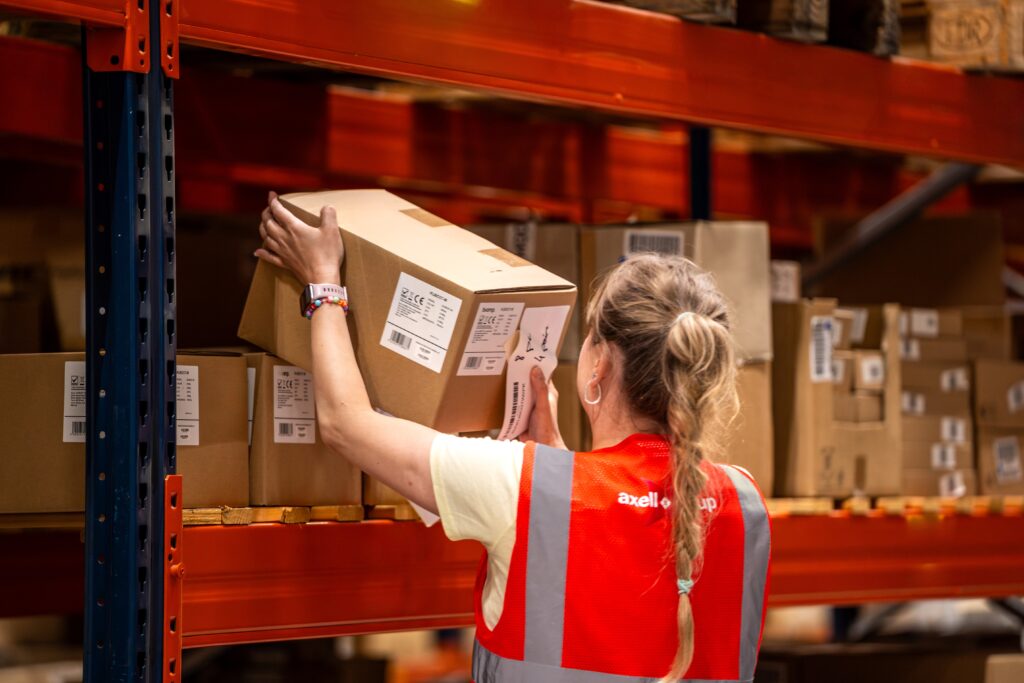
The quality of the order picking process also plays a major role. Picking errors result in incorrect or incomplete orders being shipped. This not only lowers the fulfilment rate but also leads to additional returns, higher costs and a poorer customer experience.
Supplier reliability also affects performance. When inbound goods arrive later than planned, this can immediately impact the fulfilment of customer orders. Strong collaboration throughout the supply chain is therefore essential to maintaining a high fulfilment rate.
Finally, the systems being used are equally important. Organisations that work with integrated WMS and ERP solutions generally have better visibility into inventory, order status and operational capacity. This enables them to respond more quickly whenever deviations occur.
What is the difference between fulfilment rate, OTIF and order accuracy?
The terms fulfilment rate, OTIF and order accuracy are often used interchangeably. However, each measures a different aspect of the logistics process.
The fulfilment rate focuses solely on whether an order can be delivered completely from available inventory immediately. The emphasis is therefore on product availability and order completeness.
OTIF (On Time In Full) goes one step further. This KPI measures not only whether an order is complete, but also whether it is delivered to the customer at the agreed time. An order may therefore have a high fulfilment rate but still receive a low OTIF score if the delivery is delayed.
Order accuracy focuses on the correctness of the shipment. It measures whether the customer receives the exact products, quantities and specifications that were ordered. Even when an order is delivered in full and on time, an incorrect shipment can negatively affect order accuracy.
By analysing these KPIs together, organisations gain a much more complete picture of their logistics performance than by monitoring a single indicator.
How can you improve your fulfilment rate?
Improving the fulfilment rate starts with understanding the causes of incomplete deliveries. By analysing your processes regularly, bottlenecks become visible more quickly, allowing you to implement targeted improvements.
An important first step is to optimise your inventory management. Reliable inventory data ensures that orders can be promised and fulfilled. By using real-time inventory information, you can prevent unexpected issues during the order process.
It is also advisable to evaluate order picking processes on a regular basis. Standardised procedures, clear warehouse layouts and support from a Warehouse Management System significantly reduce the likelihood of errors.
Forecasting also plays an important role. By incorporating historical sales data, seasonal trends and promotional activities into your inventory planning, you can prevent popular products from unexpectedly going out of stock.
Finally, it is important not to view the fulfilment rate as a standalone KPI. Organisations that combine this indicator with metrics such as inventory accuracy, order accuracy and OTIF gain a much better understanding of the performance of their logistics processes. This enables more targeted improvements while maintaining greater control over service quality.
How does a logistics partner support a high fulfilment rate?
As logistics processes become more complex, maintaining a high fulfilment rate becomes increasingly challenging. Growing order volumes, seasonal peaks, multiple sales channels and rising customer expectations require a logistics organisation that can adapt with flexibility.
An experienced logistics partner supports this by continuously optimising processes and providing insight into the most important performance indicators. Thanks to a modern Warehouse Management System (WMS), real-time inventory management and standardised processes, deviations can be identified and resolved more quickly. This contributes to a stable fulfilment rate and a predictable logistics operation.
In addition, a logistics partner can scale capacity during peak periods without compromising the quality of order processing. As a result, delivery performance remains consistently high, even during busy periods.
At Axell Logistics, control, visibility and continuity are at the heart of everything we do. With solutions including warehousing, Fulfilment Services, Contract Logistics and Third Party Logistics (3PL), we support organisations in optimising their logistics processes. Real-time visibility into inventory and order status provides greater control over the performance of the entire supply chain.