

















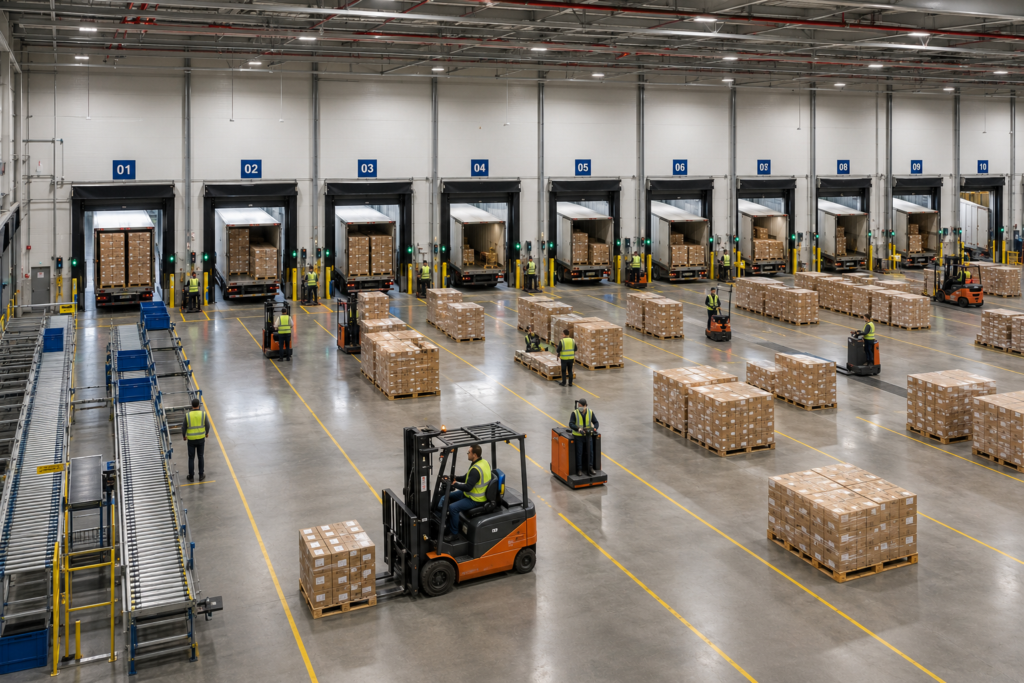
Cross-docking solutions are different ways of organising goods flows as efficiently as possible, where products are barely stored and are instead forwarded almost immediately to the next destination. Within the supply chain, this means incoming goods are quickly processed, sorted and shipped without long-term storage in a warehouse.
For many organisations, cross-docking is not one fixed standard solution, but a flexible logistics strategy tailored to volumes, delivery times and distribution structures.
Why are cross docking solutions used?
Cross-docking is used to make logistics processes faster and more efficient. Because goods remain in storage for a shorter period of time, organisations can reduce lead times and lower storage costs.
Within modern supply chains, speed is becoming increasingly important. Especially in sectors such as retail, e-commerce and distribution, there is a growing need for logistics processes that can respond flexibly to changing demand and short delivery windows.
However, not every goods flow operates in the same way. Differences in suppliers, destinations, order structures and transport networks mean there are multiple forms of cross-docking.
The right solution helps organisations structure goods flows more efficiently, absorb peak volumes and deliver faster without adding extra storage capacity.
What does this mean in practice?
In practice, the need for cross-docking often arises when traditional storage processes are no longer efficient enough.
This can happen when goods from multiple suppliers arrive simultaneously, products need to be forwarded directly to different locations or delivery times continue to shorten. Limited storage capacity can also be an important reason to redesign logistics processes.
Within retail and e-commerce, this directly impacts the supply chain. Delays in transhipment or distribution can lead to higher costs, longer delivery times or loss of visibility across goods flows.
A well-organised cross docking structure helps goods move through the supply chain more quickly while maintaining greater control over logistics operations.
How do different cross docking solutions work?
There are several forms of cross docking, depending on the structure of the supply chain and the required level of speed or flexibility.
Pre-distribution cross docking
With pre-distribution cross docking, the destination of goods is already determined before arrival. Products are immediately sorted and forwarded to fixed destinations after entering the facility.
This solution is often used within fixed distribution networks, such as retail chains or predictable goods flows. Because routing is determined in advance, the process is fast and efficient.
Post-distribution cross docking
With post-distribution cross docking, the final destination is only determined after the goods arrive. This is based on current orders, demand or inventory levels.
This form of cross docking offers more flexibility and is regularly used within e-commerce and dynamic supply chains. However, real-time visibility and reliable IT systems are essential to manage processes efficiently.
Continuous flow cross docking
With continuous flow cross-docking, goods continuously move through the logistics process without interruption. Products move almost directly from inbound to outbound transport.
This approach is mainly used for high volumes and highly optimised supply chains where speed and minimal handling are critical.
Consolidation cross docking
With consolidation, smaller shipments are combined into one larger transport flow. This improves load efficiency and helps distribute transport costs more effectively.
This solution is often used in international distribution, multi-supplier environments or complex goods flows.
Deconsolidation cross docking
Deconsolidation works the opposite way. Large shipments are divided into smaller deliveries for different customers, stores or distribution points.
This is widely used within retail distribution and detailed logistics networks where fast delivery to multiple destinations is essential.
What are the benefits of cross docking solutions?
A well-structured cross docking strategy can improve speed, flexibility and operational control within the supply chain.
Because goods spend less time in storage, storage costs are often reduced and products can be delivered faster. It also creates greater visibility across goods flows and allows logistics operations to scale more efficiently during peak periods.
At the same time, cross-docking requires close coordination between planning, transport and IT systems. Because goods are processed almost immediately, there is little room for delays or operational errors.
Real-time visibility, reliable transport planning and strong process coordination are therefore essential for successful cross-docking operations.
How can a logistics partner support cross-docking?
Successfully implementing cross-docking requires operational visibility, process control and a well-coordinated supply chain.
A logistics partner can help by analysing goods flows, determining the right cross-docking structure and aligning logistics processes efficiently. Real-time visibility and flexible capacity also play an important role.
In practice, cross docking is often combined with solutions such as warehousing, contract logistics and distribution. By integrating these processes, organisations create a stable and scalable logistics operation that can respond more effectively to growth and changing market demand.
