















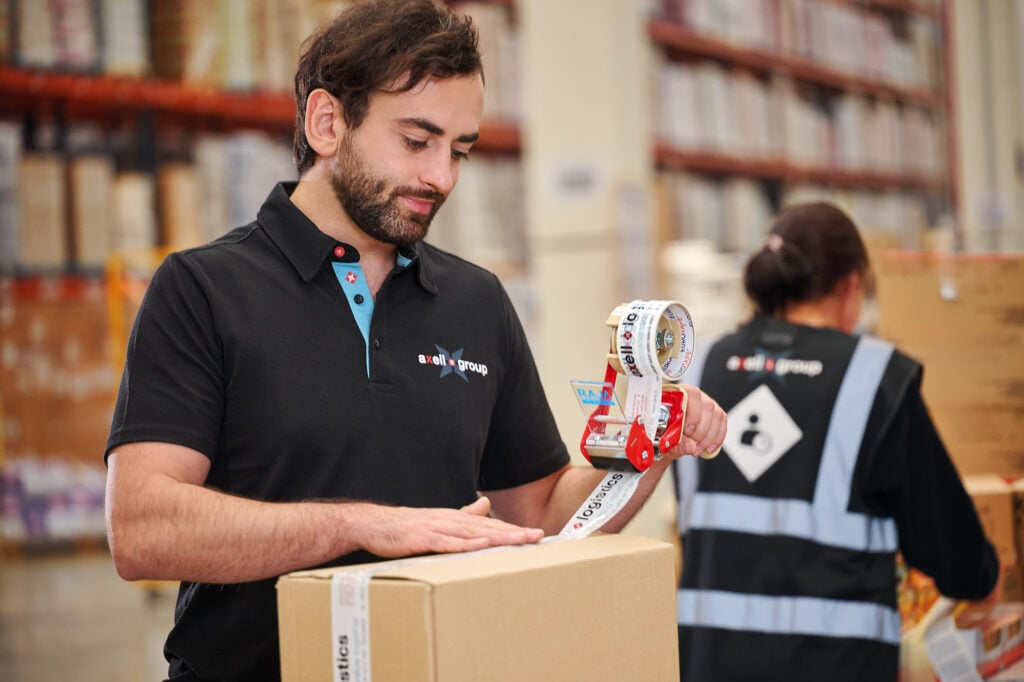
Labelling is the process of applying information to products, packaging, boxes or pallets using a label, sticker or barcode. Within logistics, labelling is used to correctly identify, track and efficiently process goods throughout the supply chain.
A proper label contains important information such as an item number, barcode, batch number, product description or shipping information. This allows products to be received, stored, picked and shipped more quickly.
What does labelling mean in logistics?
Within logistics processes, labelling ensures that goods remain identifiable and traceable at all times. A label functions as a digital or physical source of information that helps employees, carriers and systems process products correctly.
Labelling is applied during various stages of the supply chain, including:
- Receiving goods
- Warehouse storage
- Order picking
- Order packing
- Shipping to customers or retailers
Without correct labelling, the risk of errors, delays and incorrect deliveries increases significantly.
Why is labelling important?
More and more companies have specific requirements regarding how products must be supplied. Retailers, webshops and distribution centres often work with fixed barcode or labelling standards.
Correct labelling offers several advantages:
Faster processing
Warehouse employees can identify and process products more quickly.
Improved traceability
Products can be easily tracked throughout the entire goods flow.
Fewer errors
The likelihood of incorrect deliveries or inventory discrepancies is reduced.
More efficient inventory management
Real-time visibility of product locations becomes easier.
For organizations that handle large numbers of products, labelling is therefore an important part of an efficient supply chain.
What types of logistics labels exist?
Not every label serves the same purpose. Various types of labels are used within logistics.
Product labels
These labels contain product information, item codes, batch numbers or expiration dates.
Barcode labels
Barcodes make it possible to scan products quickly and process them automatically within warehouse and ERP systems.
Shipping labels
These labels contain delivery information, tracking details and transportation data.
Pallet labels
Pallet labels are used to identify complete loads or pallets within warehouses and distribution centres.
Retail labels
Some retailers have specific label requirements, such as GS1 codes or customer-specific product information.
How does labelling work in practice?
In practice, labelling often takes place before products are stored or shipped. When goods arrive at a warehouse, labels can be checked or applied before they continue through the process.
Within modern warehousing, labels are often linked to a Warehouse Management System (WMS). This allows products to be automatically registered and tracked.
An example is an e-commerce company that receives products from a supplier without barcodes. Before the products are stored, barcode labels are applied. Orders can then be processed and shipped more efficiently.
Benefits and considerations of labelling
Labelling offers many advantages, but it also requires accuracy.
Benefits
Greater efficiency
Products can be processed more quickly.
Improved inventory accuracy
Inventory discrepancies are reduced.
Enhanced customer satisfaction
Correct deliveries result in fewer complaints.
Considerations
Accurate data is essential
An error on a label can lead to mistakes throughout the entire goods flow.
Customer-specific requirements vary
Retailers and marketplaces may have different labelling requirements.
Process alignment remains important
Labelling must align with warehousing, fulfilment and transportation processes.
How does a logistics partner support labelling?
Many organizations outsource labelling activities to a logistics partner. This is often done as part of additional logistics services.
Within Value Added Services, products can be provided with barcodes, shipping labels, retail labels or customer-specific labels before they are stored or shipped.
Labelling also plays an important role within fulfilment services. Correct labelling ensures that orders can be processed more quickly and comply with the requirements of customers, retailers and marketplaces.