














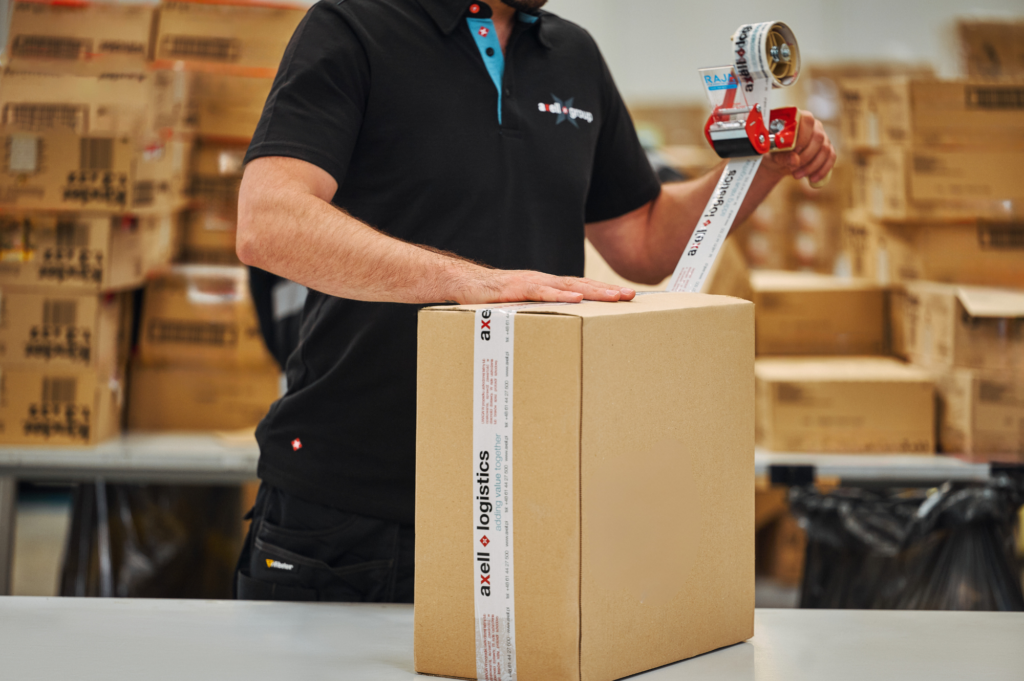
Value Added Services (VAS) are additional logistics activities performed alongside storage and transportation. These activities add extra value to products or orders before they reach the end customer. Examples include labeling, repacking, bundling, kitting, or assembling promotional packaging.
Within modern supply chains, Value Added Services play an increasingly important role. Companies want to respond more quickly to customer demands, seasonal promotions, and changing market conditions. By carrying out additional logistics activities within the warehouse, processes can be organized more efficiently and products need to be moved less frequently between different locations.
What do Value Added Services mean?
Translated literally, Value Added Services means “services that add value.” Within logistics, this refers to activities that go beyond standard storage and transportation.
While warehousing focuses on storing goods and distribution focuses on transporting them, Value Added Services add additional handling activities to the logistics process. As a result, products are immediately ready for sale, distribution, or use by the end customer.
VAS enables logistics processes to be organized in a smarter, more flexible, and customer-focused way.
These services are particularly common within retail, e-commerce, fashion, and high-tech industries.
Which activities fall under VAS?
Value Added Services can vary by sector, but several activities are commonly performed.
Examples of frequently used VAS activities include:
- Labeling and relabeling products
- Repacking goods
- Creating product bundles
- Kitting and assembly
- Promotional packaging
- Returns processing
- Product personalization
- Adding manuals or marketing materials
For example, a retailer may organize a promotional campaign in which multiple products are sold as a package. Instead of having these packages assembled in advance by the manufacturer, this can be done within the warehouse. This creates greater flexibility and allows companies to respond more quickly to market demand.
Why do companies use Value Added Services?
More and more organizations are looking for ways to make their supply chains more efficient. Value Added Services support this by performing additional activities directly within the logistics process.
As a result, companies can:
- Respond more quickly to market developments.
- Use less internal logistics capacity.
- Adapt products to specific customer or market requirements.
- Handle peak periods more effectively.
- Simplify complex logistics processes.
For many organizations, Value Added Services provide a way to increase flexibility without making additional investments in personnel or infrastructure.
This is particularly valuable in sectors where demand patterns fluctuate significantly, such as retail and e-commerce.
Benefits and considerations of Value Added Services
Benefits
Greater flexibility
Products can be adapted at a later stage to specific customer or market requirements.
More efficient processes
Additional activities take place at the same location as storage, reducing unnecessary transportation movements.
Faster product launches
Promotions, product bundles, or customized packaging can be rolled out more quickly.
Better scalability
Logistics processes can be scaled up more easily during busy periods.
Higher customer satisfaction
Products are better aligned with the needs of customers and buyers.
Considerations
Good process alignment is essential
Additional activities must integrate seamlessly with storage and distribution processes.
Inventory management becomes more complex
More handling activities within the warehouse require accurate registration and planning.
Quality control remains important
Additional handling increases the importance of clear work instructions and quality checks.
How can a logistics partner support this?
For many organizations, it is more efficient to outsource additional logistics activities to a specialized logistics partner. This allows storage, order processing, and additional handling activities to take place within one integrated process.
Within modern logistics operations, Value Added Services are often combined with warehousing and contract logistics. This provides greater visibility, shorter lead times, and a more efficient flow of goods.
By performing additional activities directly within the warehouse, greater flexibility is created within the supply chain, allowing organizations to respond more quickly to changing customer needs.