













A logistics process includes all activities required to move goods, information, and materials from point A to point B. This process often starts with the procurement or production of goods and ends with delivery to the customer. Within a supply chain, logistics processes play an important role because they ensure an efficient flow of goods and reliable delivery.
Whether it concerns a retailer, e-commerce company, or manufacturer, poorly organized logistics processes quickly lead to delays, higher costs, and dissatisfied customers.
What does a logistics process mean?
A logistics process consists of a series of interconnected steps that ensure products are available at the right time, in the right location, and in the right quantity.
This is not limited to transportation. Activities such as inventory management, warehousing, order processing, and distribution are also part of the logistics process.
A simple example is an online store receiving an order. Once a customer places an order, products must be picked, packed, shipped, and delivered. All of these steps together form a single logistics process.
The goal of a logistics process is always the same: to move goods through the supply chain as efficiently as possible, at manageable costs and with a high level of delivery reliability.
Which steps are part of a logistics process?
Although processes differ between organizations, the following components are almost always involved.
Procurement and receiving
Goods are purchased from suppliers and received in a warehouse or distribution center. Quantities, quality, and delivery times are checked during this stage.
Warehousing and inventory management
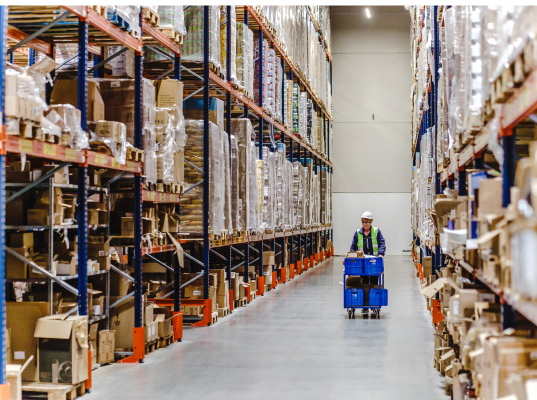
After receipt, products are stored. Effective inventory management prevents both shortages and excess inventory.
Modern warehouses use Warehouse Management Systems (WMS) to provide real-time visibility into inventory levels and goods flows.
Order processing
When a customer places an order, it is processed. Products are picked, checked, and prepared for shipment.
Transportation and distribution
After order processing, goods are transported to stores, distribution centers, or end customers. Speed, reliability, and cost are important factors in this process.
Returns processing
In many sectors, such as e-commerce and retail, returns are a standard part of the logistics process. Products are inspected, restocked, or processed according to established procedures.
What does this mean in practice?
In practice, the quality of logistics processes often determines the difference between a smoothly operating organization and one that constantly encounters problems.
Many companies face challenges such as:
- Incorrect inventory levels
- Delayed deliveries
- High storage costs
- Inefficient order processing
- Lack of visibility into goods flows
When processes are not properly aligned, delays and additional costs occur. In addition, the likelihood of errors increases.
A well-designed logistics process provides greater control, higher delivery reliability, and improved customer satisfaction. This is especially important in sectors with large volumes or fluctuating demand.
Benefits and considerations of logistics processes
Benefits
Lower operational costs
Efficient processes reduce waste, unnecessary transportation movements, and excess inventory.
Improved delivery reliability
Goods are processed and delivered faster and more accurately.
Greater visibility
Real-time data makes it easier to monitor performance and identify bottlenecks.
Increased scalability
A well-organized logistics process can grow more easily alongside the organization.
Considerations
Increasing complexity
As companies grow, logistics processes often become more complex.
Dependence on systems
Reliable data requires well-functioning IT systems and integrations.
Coordination between parties
Suppliers, carriers, warehouses, and customers must work together effectively to keep the process running smoothly.
This is precisely why more and more organizations are investing in process optimization and digital support.
How does a logistics partner support this?
Many organizations choose to outsource certain logistics processes to specialized service providers. This allows them to focus on their core activities while logistics processes are managed professionally.
A logistics partner can provide support with storage and inventory management through warehousing. This creates greater visibility into inventory levels and goods flows.
In addition, contract logistics can help align various logistics activities more effectively. This contributes to a more efficient supply chain and greater control over daily operations.
For companies that want to outsource a large part of their logistics activities, a 3PL solution offers additional flexibility, scalability, and operational support.