

















Lead time in logistics is the total amount of time that passes between the moment an order is placed and the moment it is delivered. Within the supply chain, lead time is an important performance indicator because it directly affects inventory management, delivery reliability and customer satisfaction.
A short and predictable lead time helps organizations plan more efficiently, hold less inventory and respond more quickly to changes in the market.
What does lead time mean?
The term lead time refers to the total duration of a logistics process. This can involve the time between ordering raw materials and receiving them in the warehouse, but also the period between a customer order and the final delivery.
Lead time often consists of multiple components, such as:
- Order processing
- Production or order picking
- Transportation
- Receipt and processing by the customer
For example, a supplier may have a lead time of ten working days. This means that an order takes an average of ten working days from the moment it is placed until delivery.
The shorter and more reliable the lead time, the better an organization can plan its processes.
What does lead time mean in practice?
In practice, lead time plays an important role in almost every supply chain. Companies use this information to manage inventory, plan production and meet delivery commitments to customers.
Suppose a retailer sells a popular product. If the supplier has a lead time of four weeks, the retailer must take this into account when replenishing inventory. If this period is underestimated, there is a risk of stock shortages and lost revenue.
Lead time also has a major impact on distribution. Faster and more predictable deliveries provide greater flexibility and higher customer satisfaction.
How is lead time calculated?
Calculating lead time is relatively simple:
Lead time = delivery date – order date
An example:
- Order placed on June 1
- Delivery received on June 8
The lead time is therefore 7 days.
In practice, a distinction is often made between different types of lead times, such as:
- Procurement lead time – time between placing an order with a supplier and receiving it.
- Production lead time – time required to manufacture a product.
- Transportation lead time – time required for shipping and delivery.
- Order lead time – total duration from customer order to delivery.
Measuring these components separately provides greater insight into potential bottlenecks within the logistics chain.
Benefits of a short lead time
A short lead time offers organizations several advantages.
Better inventory management
Companies need to hold less safety stock when products are available more quickly.
Higher customer satisfaction
Customers receive their orders faster and experience greater reliability.
Greater flexibility
Organizations can respond more quickly to changes in demand or market conditions.
Lower costs
An efficient supply chain prevents unnecessary storage and inventory costs.
Key considerations in lead time management
Although a short lead time is attractive, it is not only about speed.
Predictability is often more important than maximum speed. When delivery times fluctuate significantly, it becomes difficult to accurately plan inventory and production.
In addition, several factors can influence lead time:
- Availability of raw materials
- Supplier capacity
- Transportation delays
- Customs processes
- Seasonal peaks
- Internal logistics processes
By continuously monitoring these factors, organizations gain greater control over the supply chain.
How does a logistics partner support this?
Reducing and managing lead times requires insight, capacity and well-organized processes. A logistics partner can provide support by organizing storage, order processing and distribution more efficiently.
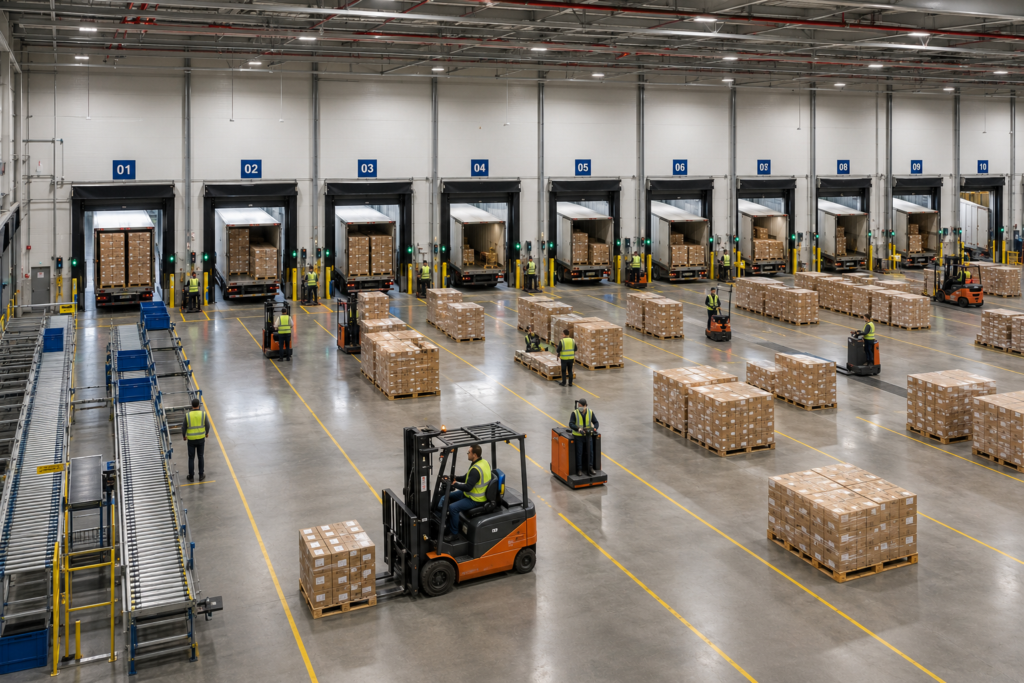
With professional warehousing, organizations gain greater control over inventory levels, order flows and product availability. This enables goods to be processed and shipped more quickly.
Contract logistics also helps companies align logistics processes more effectively with market demand. Thanks to real-time visibility, scalable capacity and streamlined processes, greater predictability is achieved throughout the supply chain.