















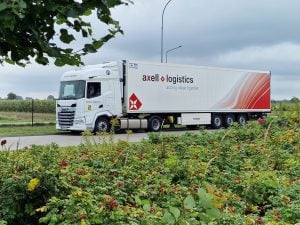
Drop density is an important logistics KPI that provides insight into the efficiency of distribution routes. The more delivery addresses a carrier can serve within a limited geographical area, the higher the drop density. A high drop density generally leads to lower transportation costs, more efficient routes and better vehicle utilisation. For organisations that distribute goods on a daily basis, this KPI therefore plays an important role in controlling logistics costs.
What is drop density?
Drop density describes the number of deliveries made within a specific geographical area or during a single transport route. Simply put, this KPI indicates how “closely grouped” the delivery addresses are.
When a driver can deliver to many customers within the same region during one trip, the drop density is high. If the delivery locations are spread far apart, the drop density is considered low. In that case, more kilometres are driven for a relatively small number of deliveries, reducing transport efficiency.
Within distribution and last-mile logistics, drop density is often used to assess and optimise routes. The KPI helps companies gain insight into the relationship between kilometres travelled, the number of stops and the total transportation costs.
Why is drop density important?
Transportation costs consist of more than just fuel consumption. Driver deployment, vehicles, maintenance, planning and administrative processes also contribute to the total cost of a trip. That is why it is important to utilise transport capacity as efficiently as possible.
A high drop density allows a truck to complete more deliveries without travelling long distances between destinations. As a result, costs are spread across multiple deliveries, reducing the average cost per stop.
In addition, a higher drop density contributes to more efficient use of drivers and vehicles. Less time is lost travelling between delivery locations, leaving more capacity available for additional routes or extra assignments.
From a sustainability perspective, a high drop density also offers advantages. Fewer kilometres driven generally means lower fuel consumption and reduced CO₂ emissions. This makes efficient route planning not only financially attractive but also increasingly important within sustainable logistics policies.
How does drop density affect transportation costs?
The relationship between drop density and transportation costs is relatively straightforward. As more deliveries take place within a smaller geographical area, the average cost per delivery decreases.
Suppose a truck delivers to ten customers located within the same business park. The driver only has to travel short distances between the different delivery locations. Total driving time remains relatively low while many deliveries are completed. As a result, transportation costs can be spread across multiple deliveries.
In the opposite situation, those same ten customers are spread across different provinces or regions. The driver travels significantly more kilometres, consumes more fuel and spends more time on the road. Although the number of deliveries remains the same, the cost per delivery increases considerably because travel time and operating costs rise.
For companies with an extensive distribution network, even a relatively small improvement in drop density can therefore lead to significant annual cost savings.
Which factors influence drop density?
Drop density is determined by a combination of geographical, operational and commercial factors. Although some circumstances are difficult to influence, many organisations can organise their distribution processes in such a way that vehicles are utilised more efficiently.
One of the most important factors is the geographical distribution of customers. When many customers are located within a relatively small area, multiple deliveries can be combined into a single route. If customers are spread across a large service area, travel time between deliveries increases and drop density decreases.
The quality of route planning also plays a major role. Modern route planning software can combine deliveries intelligently while taking driving distances, delivery time windows and traffic conditions into account. This prevents unnecessary kilometres and enables drivers to complete more stops within the same working hours.
Delivery frequency also has an impact. Companies that ship small consignments every day often create a lower drop density than organisations that consolidate orders and deliver less frequently. By scheduling delivery moments strategically, transport movements can be significantly reduced without compromising service levels.
Finally, the size of the distribution network plays an important role. Logistics service providers that transport goods for multiple customers simultaneously can combine deliveries more easily. This naturally creates more efficient routes and increases drop density.
What is the difference between drop density and load factor?
Drop density and load factor are often confused, but they measure two different aspects of the transportation process.
Load factor indicates how much of a vehicle’s loading space or weight capacity is actually being utilised. For example, a truck may leave fully loaded and therefore have a high load factor.
Drop density, on the other hand, looks at the number of deliveries made within a specific geographical area or during a single transport route. A truck may therefore be fully loaded but still have a low drop density if the delivery locations are spread far apart.
The opposite is also possible. A vehicle may carry a lighter load but still complete a highly efficient route thanks to a large number of deliveries within the same region. To effectively control transportation costs, it is therefore important to evaluate both KPIs together.
How can you improve drop density?
Increasing drop density starts with a critical analysis of your distribution network. By organising deliveries more intelligently, vehicles can serve more customers without driving additional kilometres.
One effective measure is order consolidation. When multiple orders for the same region are combined, routes become more efficient and the number of deliveries per trip increases. This not only reduces the cost per delivery but also decreases the workload for drivers and vehicles.
In addition, the strategic positioning of warehouses and distribution centres can contribute to a higher drop density. By storing inventory closer to customers, transport distances become shorter and deliveries can be combined more easily.
Collaboration within the logistics chain also creates opportunities. Logistics service providers that consolidate goods from multiple customers often achieve a higher drop density than organisations that rely solely on their own transport volumes. This allows vehicles to be utilised more efficiently while keeping transportation costs under control.
Increasingly, these processes are supported by data analysis and route optimisation software. By combining historical order data, traffic information and customer locations, planners can continuously improve routes and respond more quickly to changes in demand.
How does a logistics partner support a higher drop density?
Increasing drop density requires more than effective route planning alone. As distribution networks expand, order volumes fluctuate and customer expectations continue to rise, organising transportation efficiently becomes increasingly complex. An experienced logistics partner has the expertise, systems and scale to consolidate distribution flows intelligently and continuously optimise routes.
By using advanced Transport Management Systems (TMS), real-time planning information and an extensive distribution network, transport routes can be organised more efficiently. Deliveries are consolidated wherever possible, allowing vehicles to complete more deliveries within the same region while travelling fewer unnecessary kilometres. This not only reduces transportation costs but also creates a more reliable distribution process.
In addition, a logistics partner provides the flexibility to scale capacity during peak periods without compromising efficiency. By combining warehousing, distribution and transportation, an integrated logistics chain is created in which goods flows are optimally coordinated.
At Axell Logistics, control, efficiency and continuity are at the core of everything we do. With solutions in distribution, transport within the Netherlands, international transport and contract logistics, we support organisations in optimising their distribution networks. By organising goods flows intelligently and providing real-time visibility, we help companies further improve their transportation performance.
Would you like to discover how your distribution network can be organised more efficiently? Find out how our distribution and transportation solutions can help reduce transportation costs and create a higher-performing supply chain.