











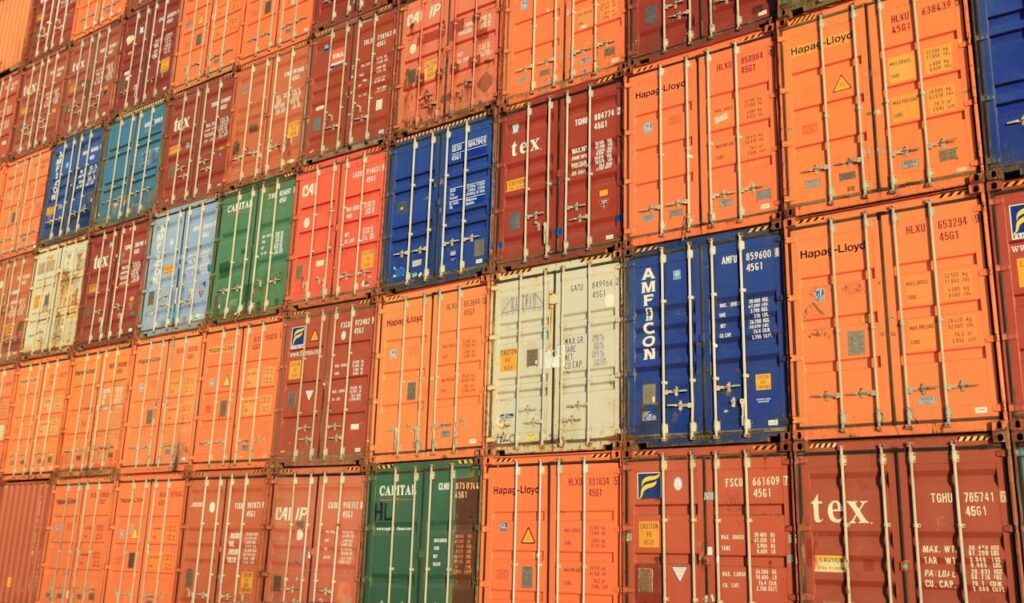
Sea freight is the transportation of goods by ship between ports worldwide. It is one of the most commonly used modes of transport for international trade and plays an important role within the global supply chain. Especially for large volumes and long distances, sea freight offers an efficient and cost-effective solution for import and export.
Virtually all consumer products that arrive in Europe from Asia, North America, or other continents are transported to a large extent via sea container transport. Examples include clothing, electronics, packaged food products, and industrial goods.
What does sea freight mean?
In sea freight, goods are transported in containers that are shipped between ports by cargo vessels. These containers provide protection against weather conditions and make it possible to transport large quantities of goods efficiently.
The most commonly used containers are 20-foot and 40-foot containers. Depending on the volume, companies can choose a full container or a shared container.
Sea freight is often used when speed is less important than cost control. Although transit times are longer than with air freight, transportation costs per product are generally significantly lower.
What does sea freight mean in practice?
For many companies, sea freight is an essential part of their international goods flow. Products are manufactured in one country, shipped by container to a port in Europe, and then transported onward to a distribution center, warehouse, or final destination.
This process helps organizations to:
- Transport large volumes efficiently
- Keep transportation costs under control
- Utilize international suppliers
- Store inventory at strategic locations
Sea freight is widely used within retail, e-commerce, food, and high-tech supply chains. Companies importing goods from Asia in particular make daily use of container transport.
How does sea freight work?
The sea freight process generally consists of several steps:
- Goods are collected from the supplier or manufacturer.
- The goods are loaded into a container.
- The container is transported to the port of departure.
- The cargo vessel transports the container to the port of arrival.
- Customs clearance takes place after arrival.
- The goods are stored or further distributed to their final destination.
FCL (Full Container Load)
With FCL, one company rents an entire container. This is often attractive when there is sufficient volume to fill the container completely. It provides greater control over the goods flow and limits the number of handling moments.
LCL (Less than Container Load)
With LCL, multiple companies share one container. This is a suitable solution for smaller shipments where a full container is not required. As a result, transportation costs remain manageable, even for lower volumes.
Benefits and considerations of sea freight
Sea freight offers several advantages for international logistics.
Benefits
- Low transportation costs per unit
- Suitable for large volumes
- Worldwide reach
- Efficient for import and export flows
- Ability to combine different goods flows
At the same time, there are also considerations to take into account.
Considerations
- Longer transit times than air freight
- Dependence on sailing schedules and port processes
- Possible delays due to weather conditions or congestion
- Proper inventory planning is essential
Companies that use sea freight must therefore carefully align their logistics processes with delivery times and inventory levels.
How does a logistics partner support this?
Sea freight does not stop when a container arrives at the port. In fact, an important part of the logistics process begins at that point. Goods need to be stored, processed, and further distributed to customers, stores, or production facilities.
A logistics partner can provide support with warehousing, inventory management, and distribution. This creates greater control over the entire goods flow and helps prevent unnecessary delays.
For companies looking to further optimize their logistics processes, contract logistics can also play an important role. In this approach, storage, inventory management, and operational processes are integrated into one logistics solution.
Would you like to learn more about the possibilities surrounding international goods flows and onward transportation within Europe? Then discover more about international transport.