














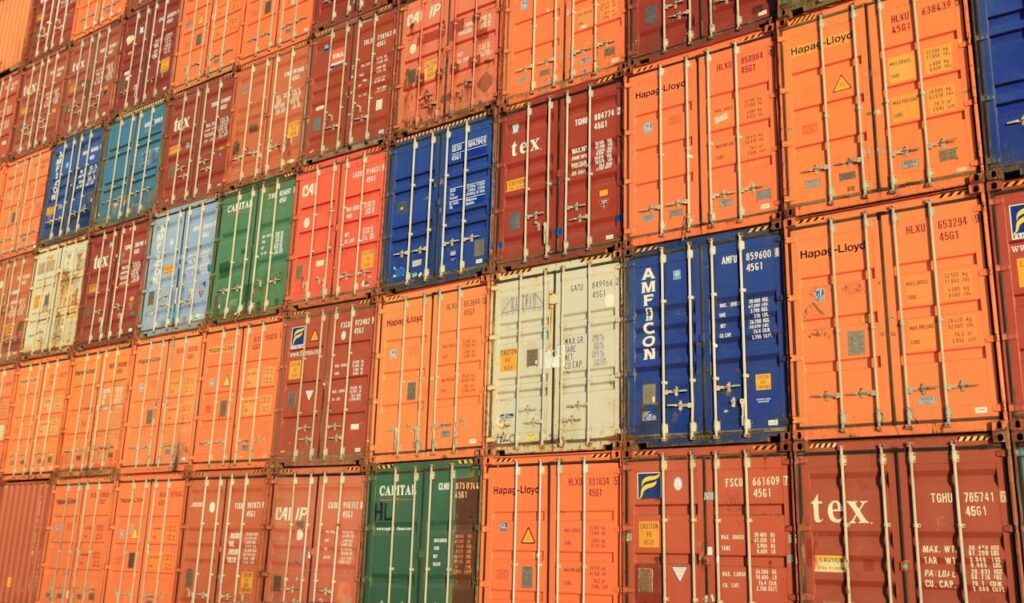
Container transport is the transportation of goods in standardised containers via different modes of transport, such as trucks, trains and ships. By transporting goods in a sealed container, shipments can be moved efficiently, safely and on a large scale. Container transport forms the foundation of a large part of international trade and plays an important role within modern supply chains.
Thanks to the use of standard containers, goods can be easily transferred between different means of transport without having to move the cargo itself. This makes container transport a reliable and cost-efficient solution for international goods flows.
What does container transport mean?
In container transport, goods are packed into a container that remains sealed throughout the entire transport journey. The container functions as a single transport unit and can be transported by ship, train or truck.
The most commonly used containers are:
- 20 ft containers
- 40 ft containers
- High Cube containers
- Reefer containers for temperature-controlled goods
- Open Top containers for oversized or non-standard cargo
Because containers are designed according to fixed global standards, logistics processes can be organised efficiently and goods can be transferred quickly between different modes of transport.
What does this mean in practice?
Container transport is used for a wide variety of goods flows. Examples include consumer goods, industrial products, raw materials and packaged food products.
For example, a manufacturer in Europe can load goods into a container, which is then transported by truck to a terminal. The container subsequently travels by train or ship to its final destination, where the goods are further distributed.
For companies involved in international transport, container transport provides a scalable solution for moving large quantities of goods efficiently over long distances.
How does container transport work?
Container transport consists of several logistics steps that connect seamlessly.
Loading the container
The goods are carefully loaded and secured inside the container. Factors such as weight, stability and cargo protection are taken into account.
Pre-carriage
The container is transported by truck or train to a port or transhipment terminal.
Main transport
Depending on the destination, the container is transported by ocean vessel, inland waterway vessel or train. Particularly in international transport, a large part of the journey is often completed by sea.
Transhipment and onward transport
After arrival at the destination, the container is transferred to another mode of transport for the final part of the journey.
Because the goods remain in the same container throughout these stages, the risk of damage is reduced and the process remains clear and manageable.
What are the benefits of container transport?
Container transport offers several advantages for organisations operating internationally.
Safe transport
Goods remain protected throughout the entire journey against weather conditions, damage and unauthorised access.
Efficient transhipment
Containers can be transferred quickly between trucks, trains and ships without moving the goods themselves.
Scalability
Container transport makes it possible to transport both small and large volumes efficiently.
Global reach
Thanks to international ports and transport networks, goods can be delivered almost anywhere in the world.
Cost control
For larger volumes, container transport often provides a favourable balance between transport costs and loading capacity.
Considerations in container transport
Although container transport offers many advantages, there are also several considerations.
Transit times can be longer
Particularly in international sea transport, transit times can be significantly longer than with road transport.
Good planning remains essential
Capacity, sailing schedules, customs formalities and transhipment moments require accurate logistics planning.
Not every goods flow is suitable
Highly time-sensitive goods or products with specific requirements may require alternative transport solutions.
How does a logistics partner support this?
Container transport often involves more than just moving a container. Storage, inventory management, customs clearance and distribution also play an important role within the overall goods flow.
A logistics partner can provide support with the planning and coordination of container transport operations and ensure efficient integration with distribution and warehousing processes. This creates greater visibility across the entire supply chain and allows goods flows to be managed more effectively.
When transport and storage are combined within a contract logistics solution, greater control is achieved over inventory, delivery reliability and operational processes.